PCOS Without The Pill. Is It Really The Only Way?
Why India’s Gen Z Is Questioning Birth Control as the Default Answer, and What the Research Actually Shows
Is birth control the only option for treating PCOS? No. The pill manages symptoms like irregular bleeding by suppressing ovulation, but it doesn’t correct the insulin resistance or hormonal imbalance actually driving the condition. Root-cause approaches, TCM acupuncture, targeted diet change, and yoga, are evidence-backed alternatives that treat PCOS rather than mute it.
India’s PCOS rates in young women now run well above the global average, and most cases go undiagnosed for years. This article walks through a real patient’s fourteen-year PCOS story, the actual mechanism behind contraceptive clotting risk, what untreated PCOS quietly builds toward, and the clinical evidence behind acupuncture, yoga, and diet correction as root-cause alternatives.
Is the pill actually treating your PCOS, or is it just quietly renting you time before the real bill comes due?
That’s not a rhetorical question. Sit with it for a second, because if you’re a woman in India between 18 and 30, there’s a real chance you already have PCOS, don’t know it yet, or were handed a prescription in a fifteen-minute appointment and told, gently but firmly, to stop asking questions.
Why Is PCOS Exploding Among India’s Twenty-Somethings?
Here’s a number worth sitting with: roughly 1 in 5 young Indian women now live with PCOS, well above the global average of 8–13% (Think Global Health, 2023). And that number is very likely an undercount. Close to 70% of women with PCOS worldwide go undiagnosed for years, often mistaking irregular cycles, acne, or weight gain for “just how my body is.”
What hasn’t kept pace is the treatment conversation.
Most young women still walk out of a gynaecologist’s office with one option offered, the pill, and no real explanation of what it does and doesn’t fix. It’s just what happens to a generation’s hormonal and metabolic systems when the environment around them changes faster than their biology can adapt. Diet shifted fast. Screen time replaced sleep. Desk jobs replaced movement, and stress became a permanent background setting rather than an occasional visitor. None of that is a moral failing.
This PCOS Story Started 14 Years Back
A patient recently came to Balancepoint Chinese Med Clinic in Mumbai for acupuncture support alongside IVF, after two prior IVF attempts and an IUI hadn’t worked. She’d read that acupuncture could improve her odds, and a friend who’d had a successful cycle with acupuncture support had told her the same thing. So she booked an assessment.
That’s where her actual history came out.
Diagnosed with PCOS. Put on a contraceptive pill to regulate her cycle.
Bleeding became predictable. For years, that felt like enough.
High blood pressure symptoms escalated into a stroke. Blood found dangerously thick and hypercoagulable.
She’s now on three permanent medications: a contraceptive to keep her PCOS “on border,” a blood thinner to manage the clotting risk, and a medication for blood pressure. Alongside that, she’s dealing with weight gain, ongoing hormonal imbalance, and a standing risk of another stroke.
Combined hormonal contraceptives raise clotting risk through a well-documented mechanism: estrogen alters how the liver synthesizes clotting proteins. Oral estrogen increases hepatic production of pro-coagulant factors, including fibrinogen and clotting factors II, VII, VIII, and X, while simultaneously lowering natural anticoagulants such as antithrombin and protein S (Estrogen and Thrombosis: A Bench to Bedside Review, PMC, 2020). The net effect tilts the body’s hemostatic balance toward clot formation. A 2015 Cochrane review found combined oral contraceptive users faced an overall 1.6-times higher relative risk of ischemic stroke or heart attack compared to non-users, rising to 2.4-times at higher estrogen doses (Roach et al., Cochrane Database of Systematic Reviews, 2015). For most healthy young women this risk stays low in absolute terms. But it is not zero, and it compounds with age, smoking, and existing metabolic dysfunction, exactly the profile PCOS often creates.
None of this is a suggestion to stop a prescribed blood thinner, blood pressure medication, or any other prescription without your doctor’s involvement, especially after a clotting event like a stroke. That decision belongs to you and your physician, not a blog post. The point isn’t to villainize medication. It’s to ask why root-cause options weren’t offered seriously before things escalated this far.
Is Managing PCOS the Same as Treating It? Or Just Postponing It?
Ask yourself honestly: if a pill controls your bleeding but the insulin resistance, the inflammation, and the hormonal imbalance underneath it are all still there, untouched, is that treatment? Or is it maintenance?
Maintenance keeps a condition from being visible. Treatment addresses why it’s there in the first place.
There’s a difference, and it matters more than most of us are taught to think. The pill does the former well. It was never built to do the latter. This isn’t an argument that contraceptives are useless or dangerous for everyone. For many women, at many life stages, they’re the right call. The argument is narrower and sharper: PCOS deserves to be treated as a metabolic and hormonal condition with real root causes, not managed indefinitely as if silence were the same as healing.
What Actually Happens When PCOS Is Managed Instead of Treated?
Fourteen years is a long time for an underlying condition to sit unaddressed under a controlled surface. The international evidence-based PCOS guideline, developed with over 3,000 studies and endorsed across more than 70 countries, lists exactly the complications that tend to surface over that kind of timeline (Teede et al., Human Reproduction, 2018).
- Insulin resistance that can progress toward type 2 diabetes over time
- Fibroids that develop quietly over years of hormonal imbalance
- Endometriosis that gets misread as “just bad period pain” until it affects fertility
- Low iron and hemoglobin from years of erratic or heavy bleeding, showing up as fatigue no amount of sleep fixes
- Menstrual pain normalized so long the pattern is forgotten as abnormal
- Reduced fertility, surfacing years later when a woman is finally ready to conceive
None of this is inevitable. But it is what “on border” can quietly become, one decade at a time.
The Alternative Path: TCM Acupuncture, Ayurveda, and Yoga
Here’s the part that doesn’t get said enough: women with PCOS aren’t actually choosing between “take the pill” and “do nothing.” There’s a real, evidence-backed middle path that doesn’t get equal airtime.
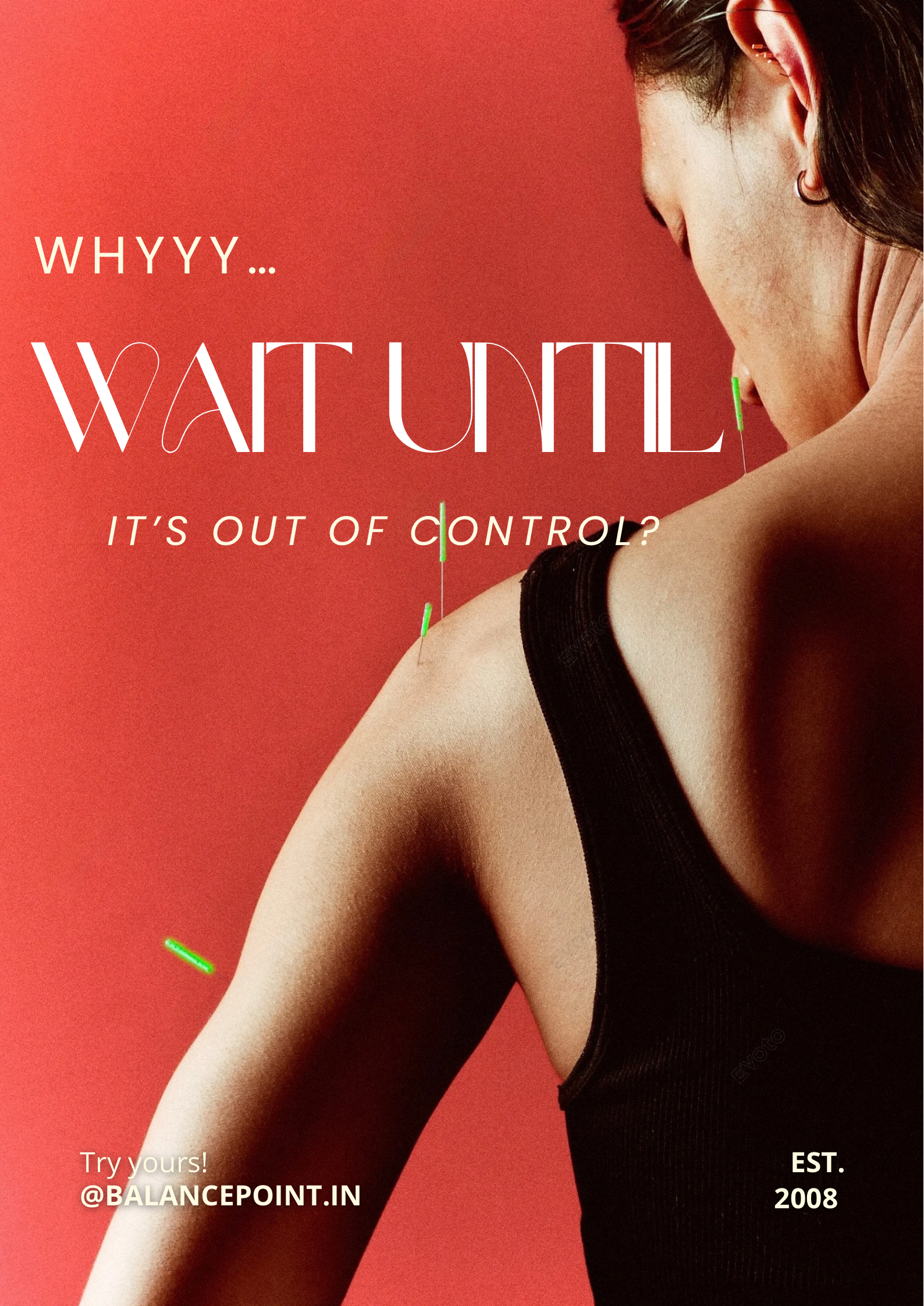
TCM acupuncture has a growing clinical evidence base specific to PCOS, not just general wellness claims. A randomized controlled trial by Johansson and colleagues found that electroacupuncture, given twice weekly over 10 to 13 weeks, significantly increased ovulation frequency in women with PCOS (Johansson et al., American Journal of Physiology-Endocrinology and Metabolism, 2013). Separate trials summarized in a 2022 mechanistic review found acupuncture lowered circulating and adipose-tissue androgens, improved LH/FSH ratios, and increased insulin sensitivity through measurable changes in insulin-signaling pathways (Frontiers in Endocrinology, 2022). At Balancepoint, treatment for PCOS typically targets Liver Qi stagnation and Spleen Qi deficiency, the TCM patterns most consistently associated with the hormonal and metabolic dysfunction driving the condition, alongside dietary and lifestyle correction.
Yoga has its own dedicated research base in exactly this population. A randomized controlled trial of adolescent girls with PCOS found a structured yoga program measurably improved glucose metabolism and blood lipid levels compared to conventional exercise (Nidhi et al., International Journal of Gynecology & Obstetrics, 2012). Ayurveda’s approach overlaps here too, built around diet correction, herbal support for insulin sensitivity, and the same underlying premise TCM works from: that the hormonal system is a feedback loop worth correcting, not a symptom to be muted.
None of these replace a doctor’s diagnosis or a genuinely necessary medication. What they offer is something the pill alone doesn’t: a way to actually move the underlying condition, not just its most visible symptom.
Why Is Gen Z Turning Back to TCM and Natural Medicine?
Gen Z doesn’t take “just take this” as a complete answer, and honestly, that instinct is a good one.
This generation researches before it accepts. It cross-references a prescription against a PubMed abstract before the next appointment. It’s why Traditional Chinese Medicine, acupuncture, and Ayurveda are seeing a real resurgence among exactly this age group in India, not as a rejection of modern medicine, but as a refusal to accept the first answer as the only answer. The clinical literature on acupuncture for PCOS alone has grown substantially over the past decade, moving from a handful of small trials to systematic reviews and mechanistic studies published in mainstream endocrinology journals, evidence a more skeptical generation was always going to go looking for.
There’s something almost old-fashioned about it, dressed up in a very modern instinct. Traditional Chinese Medicine has been in continuous clinical use for over two thousand years. Gen Z didn’t discover it. They just stopped assuming the newest option is automatically the most complete one, and started asking harder questions of both sides.
Frequently Asked Questions
- Think Global Health, “India Is Unprepared for a PCOS Crisis,” 2023. Think Global Health
- Estrogen and Thrombosis: A Bench to Bedside Review, PMC, 2020. PMC
- Roach et al., Combined oral contraceptives and risk of MI/ischemic stroke, Cochrane, 2015. PubMed
- Teede et al., International evidence-based PCOS guideline, Human Reproduction, 2018. PubMed
- Johansson et al., Acupuncture for ovulation induction in PCOS, RCT, 2013. PubMed
- Underlying mechanisms of acupuncture therapy on PCOS, Frontiers in Endocrinology, 2022. Frontiers
- Nidhi et al., Yoga program and glucose metabolism in adolescent PCOS, RCT, 2012. PubMed
Ready to Feel Like Yourself Again?
Book a consultation at Balancepoint. Priya Samwani, Licensed Acupuncturist, will assess the TCM pattern behind your PCOS — Liver Qi stagnation, Spleen Qi deficiency, or Kidney Jing depletion — and design a protocol specific to what’s actually driving it. We also come to you, anywhere in Mumbai.